

Last week I re-posted a piece I had originally put up on Medium in 2021. In that piece, I drew on a recent edited volume on the history of political allotment to provide a provisional answer to the question of whether the use of sortition as a democratic mechanism was primarily a Western phenomenon. I tentatively concluded that it was, although I had the sense that Western academics have not looked very hard for non-Western cases. As I pointed out, although the volume I was discussing constituted a significant advance in the global history of sortition, it still contained thirteen chapters on Western allotment procedures, and only one on sortition in China.
Of course, this may simply reflect the actual historical distribution of sortition. There may, in other words, be more studies of sortition in the West because the practice was in fact more common in Western than in non-Western societies. I’ve long had a sneaking suspicion, though, that there were non-Western examples of sortition (if not necessarily examples of democratic sortition) out there in the historical record that had simply not been studied in any detail by Western scholars of allotment.
That suspicion seemed confirmed when I came across ‘the Uthiramerur inscription,’ which records a sophisticated example of political allotment from 10th century AD India. The inscription and its context in the brahmadeya villages in the South Indian Chola kingdom were given a lengthy treatment by Romila Thapar, the doyenne of Indian historians, in her book Early India: From the Origins to AD 1300, which I read during my first trip to India in October 2024. This, I immediately thought, looks like the kind of solid, detailed evidence of a historical case of political sortition outside the West that would be worth looking into more deeply.
Alas, life (and the more urgent need for university reform) intervened, and I haven’t been able to get back to the inscription since. Until, that is, re-posting my old Medium piece prompted me to dig into it more deeply, and my happening to be working out of the British Library gave me the perfect opportunity to do so.
I was surprised by quite how little I was able to find on the inscriptions from the past few decades. Yves Sintomer, one of the editors of the volume mentioned above, has included a couple of pages on the inscriptions in his 2023 book The Government of Chance (an updated English version of his earlier Petite histoire de l'expérimentation démocratique - which explains why I don’t remember coming across Uthiramerur when I read that book). Other than that, though, Thapar’s treatment still seems to be the best discussion of the document in its larger social context.
The brief discussions of the inscriptions in Yalamali Subbarayalu’s South India under the Cholas focus on the meaning of particular terms. But Subbarayalu also cites some important treatments of the original text of the inscription, including its editio princeps by the renowned epigraphist R.B. Valaiyattur Venkayya as well as further epigraphic discussions in K.A. Nikalanta Sastri’s Studies in Cola [sic] History and Administration and K.V. Subrahmanya Aiyer’s Historical Sketches of Ancient Dekhan. In what follows, though, my focus will be on situating the allotment described in the inscription in the global history of democracy.
Uthiramerur is a small town in the Indian state of Tamil Nadu, a little more than a two hour drive south-west of Chennai. The town name is usually written உத்திரமேரூர் (Uthiramerur) in Tamil nowadays, though you may also see the form உத்தரமேரூர் (Uttaramerur). (Venkayya also uses ‘Uttaramalur,’ and ‘Ittiramerur’ is how the town in referred to in Sintomer’s index, though not in his main text.) The town’s historic name was Uthiramerur Chaturvedi Mangalam, with the last two terms (meaning ‘auspicious settlement of the four vedas’) indicating that this was a brahmadeya - a village set apart for Brahmins.
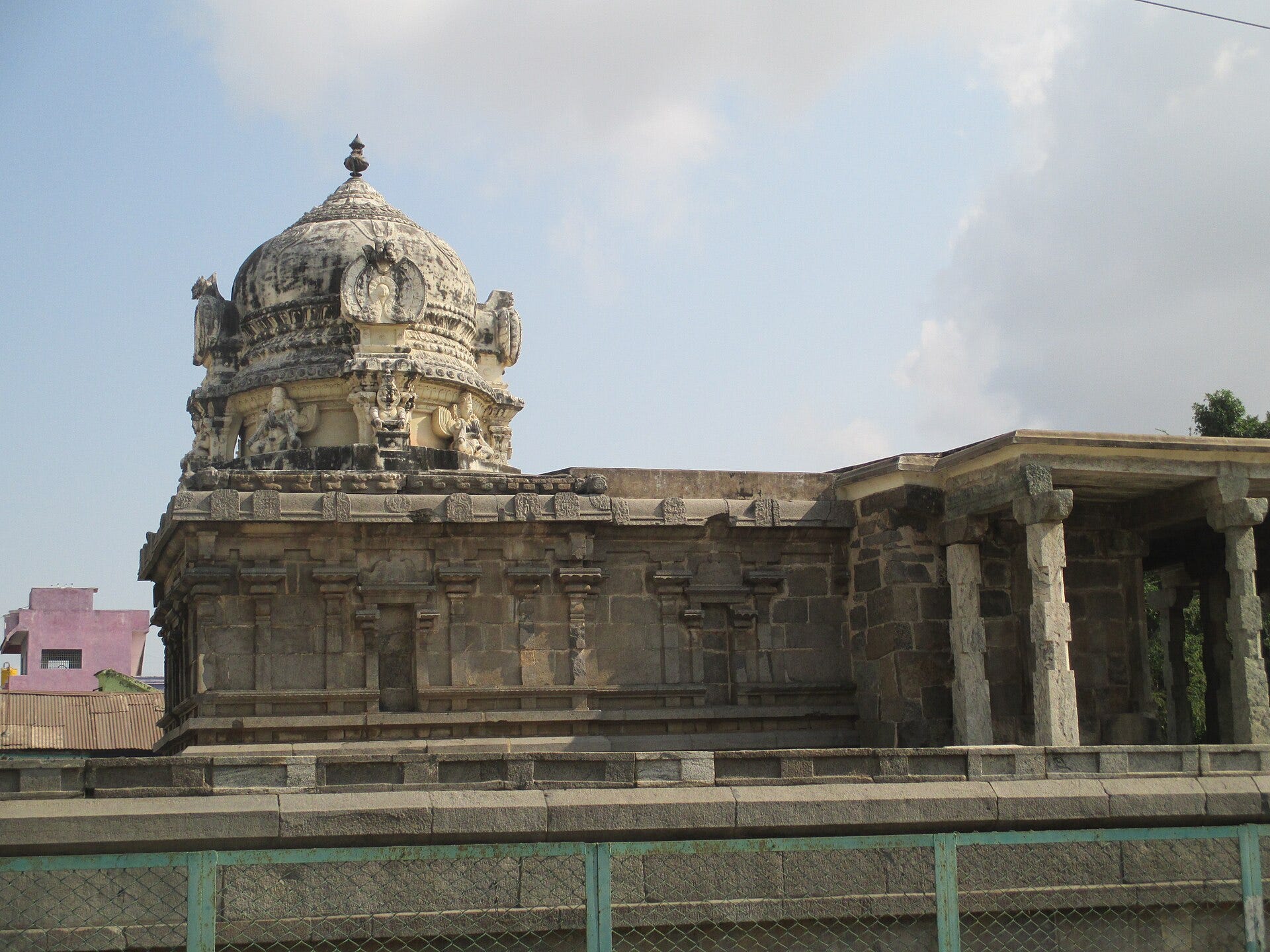
According to Sastri, Uthiramerur contains ‘numerous inscriptions…engraved on the walls of no fewer than seven temples in the vicinity’ (p. 95), some sixty of which he made use of in his general study of the town’s administration. What has put Uthiramerur on the map for historians of sortition and democracy, though, are two inscriptions in the Vaikunda Perumal Temple, which was founded in the 8th century but which has seen numerous later additions.
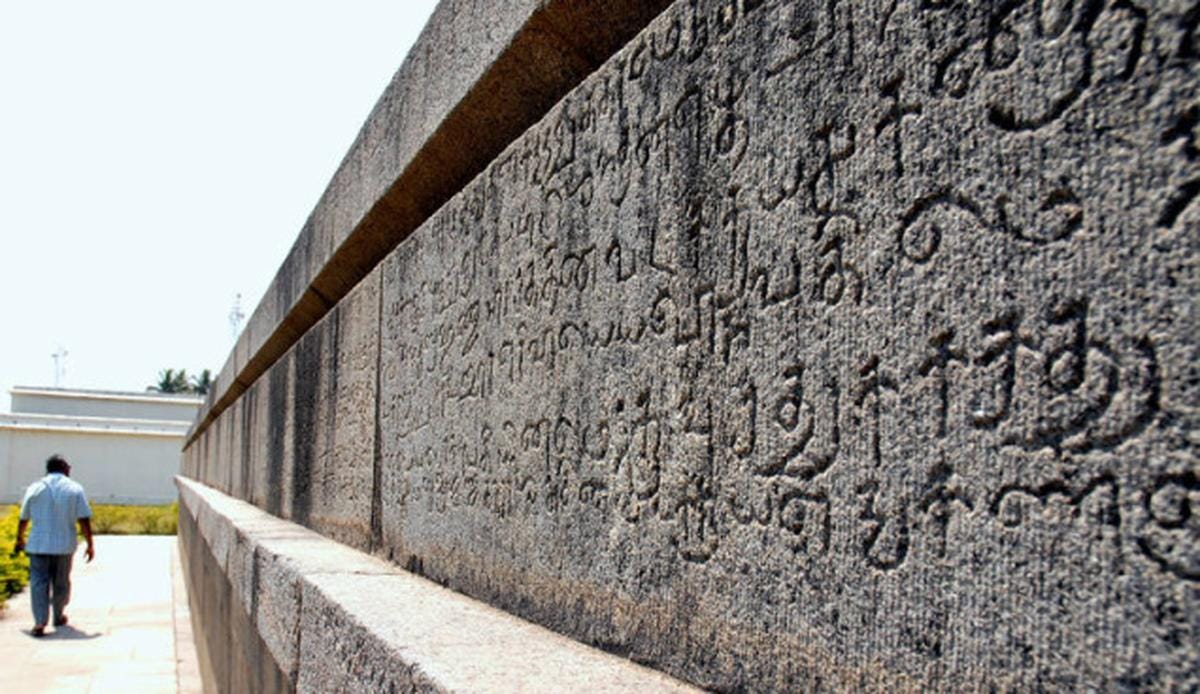
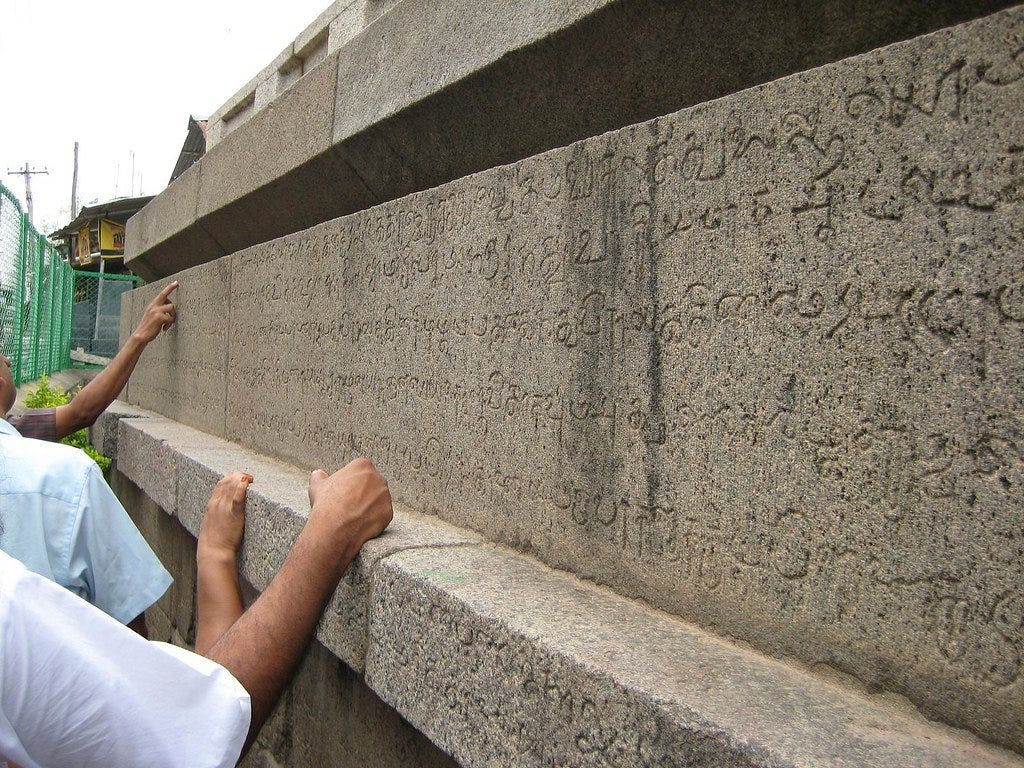
The inscriptions are inscribed on the oldest part of the temple, its base or adhisthana. The first inscription, dated to 918-19 AD, covers an area of about 2.9 by 0.6 metres, but with its three final lines straggling out to over 8 metres; the second inscription, from the year 920-21, fills a space of about 7 by 0.1 metres. Both are written in inch-high letters in the Tamil language and the Tamil script, except for a few words (in Tamil and Sanskrit) which are written in Grantha, a south Indian Brahmic script. But it is the content of the inscriptions that has made them increasingly well-known and even celebrated, not only among scholars of sortition, but also among the general public in India.
A ‘model of democracy’
On December 10th, 2020, when Prime Minister Narendra Modi laid the foundation stone for India’s new parliament building, he described the project as ‘a milestone in India’s democratic history.’ He also cited the Uthiramerur inscription, describing the arrangements recorded in it as part of India’s ‘democratic traditions’ and of a ‘history of democracy’ that was still ‘visible in every part of our country.’
Exactly a year later, on December 10th 2021, Modi returned to the topic at the global Summit for Democracy, declaring that ‘the democratic spirit’ was ‘integral’ to India’s ‘civilization ethos’ (sic), and that this ‘same democratic spirit is seen in the 10th century Uttaramerur inscription that codified the principles of democratic participation.’ That democratic spirit, he went on, could not be suppressed by ‘centuries of colonial rule,’ but ‘found full expression with India’s independence.’
In a speech on April 14th, 2023, Modi again returned to Uthiramerur, stating that India was ‘the world’s oldest democracy’ and ‘the mother of democracy,’ that ‘there are numerous historical references to this’ and that ‘an important reference’ is an inscription found in Tamil Nadu.
Many other commentators have seen Uthiramerur’s inscriptions in similar terms. In an article on the NDTV website entitled ‘This Tamil Nadu Town Had World’s Earliest Democracy Model,’ historian Nandita Krishna is quoted as repeating Modi’s claim that ‘India is the mother of democracy,’ and as adding that ‘the British went with it’ and that ‘what we had was far older and deeply rooted.’ And the article concludes that ‘Uttiramerur stands as a reminder that democratic governance in India has ancient origins - structured, codified and practised long before modern electoral institutions were born.’
The sub-title of the NDTV piece claims that ‘PM Modi’s remarks have renewed attention on the Chola-era’ system described in the Uthiramerur inscriptions. But it would seem that there was a pick-up in interest in the inscription as evidence for Indian democracy even before Modi’s remarks. In an influential article in The Hindu in 2010, for example, T.S. Subramanian had already anointed the inscriptions as evidence for an ‘Uttaramerur Model of Democracy.’
The social context
According to Thapar, ‘village assemblies were crucial to Chola administration,’ with ‘those living in the usual peasant villages’ meeting ‘in an assembly called the ur,’ whereas those from the brahmadeya villages used the superior title of sabha.’ ‘Large villages,’ she adds ‘could be divided into wards, each with a smaller assembly representing its households.’ And although ‘royal officials’ could be ‘present at the meetings of the sabha, they do not appear to have played a commanding role,’ with their participation limited to an observer or adviser role.’ ‘The degree of apparent autonomy at village level,’ Thapar concludes, ‘deserves to be underlined’ (p. 373).
Sintomer concurs. ‘Sortition,’ he says (his special interest) ‘took place in southern India, in the ancient Tamil region which comprised what are now Tamil Nadu, Kerala, and parts of Sri Lanka’ (p. 66). He goes on:
Local village autonomy developed as early as the Third Sangam period, spanning from circa sixth century BCE to circa third century CE. Some historians claim that this system included local self-government (called “the panchayat system” by modern historians) and a kind of democratic monarchy, although the latter remains contested. In the same region, more reliable sources prove that self-government developed during the medieval Cholas.
He then moves onto a discussion of the Uthiramerur inscriptions.
Pot luck
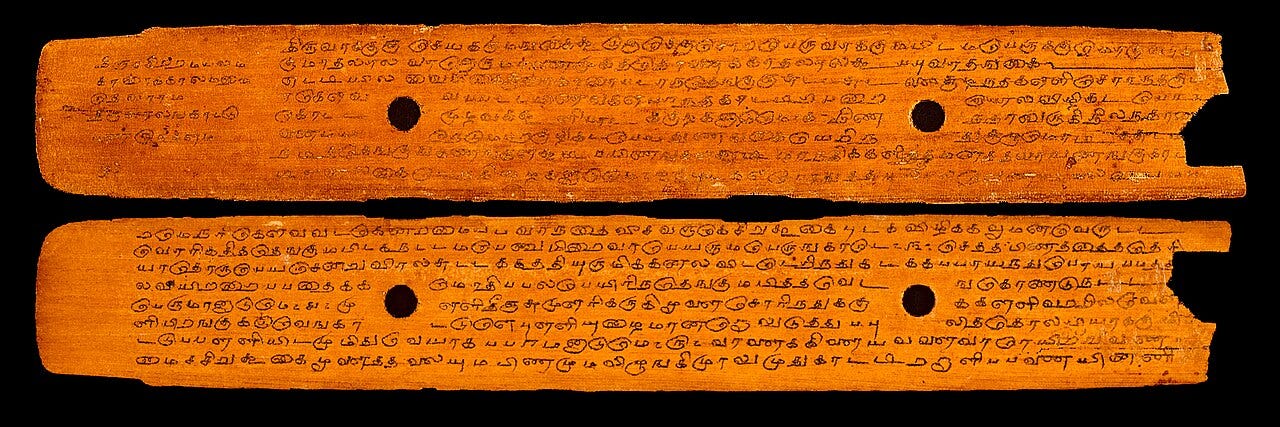
It’s easy to see why. What we have in the Uthiramerur inscriptions is unmistakably a description of allotment, and one of great interest. At the centre of it was what the inscriptions call allotment by kudavolai (குடவோலை) - literally a ‘pot-leaf’ system, a term which combines kudam (குடம்), a pot, and olai (ஓலை), a leaf. This obviously involved writing the names of candidates on leaves, placing them in a pot, and randomly drawing one or several ‘winners’ out. The leaves were palm leaves, probably of the palmyra plant (borassus flabellifer), which were widely used as writing material in pre-modern India. (The image below is of a palm-leaf manuscript of the Tamil classic the Tevaram that was copied around 1700 AD.)
In the first procedure described, there is an initial allotment from all those qualified in each of the thirty kudumbus (usually translated ‘wards,’ though Subbarayalu suggests that ‘groupings of cultivated fields’ would be more accurate (p. 61)). This allotment produces thirty ward representatives. Then there is a second series of draws, this time performed by a boy ‘who cannot distinguish any forms’ (that is, who couldn’t read) to randomly allocate the thirty ward representatives first to a Gardening Committee of twelve men, and then onto an Annual Committee, also of twelve men. The men named on the final six leaves are allocated to the six-member Water Tank Committee.
In the second allotment procedure described, each of the wards sends in a bundle of leaves (each inscribed with the names of all those qualified) wrapped in another ‘covering leaf.’ Then there is a special meeting of the assembly (sabha) at which the oldest priest present holds up a pot with all the bundles in it ‘so as to be seen by all the people.’ After that, one by one each of the bundles is taken out by ‘any boy who happens to be standing close’ and ‘who does not know what is inside,’ and transferred to a separate pot. Finally, each of these thirty pots are shaken in turn, and one leaf drawn out and placed in the hands of an arbitrator ‘who shall receive it in the palm of his hands with his five fingers spread out.’
In this second procedure, of the thirty men chosen at this ceremony, those who have already served on the Garden and Water Tank Committees ‘or who are advanced in learning or age’ are placed on the Annual Committee. The remaining 18 men are then allocated to the remaining two committees by a process referred to as ‘showing the karai,’ whose nature, as far as I have been able to ascertain, remains something of a mystery to Indologists. (Venkayya, for his part, seems to have thought the term referred to an oral airing of views.)
A lot like ancient Greece
For me, the procedures described in the Uthiramerur inscriptions are fascinating in part because of their distinctiveness as thoroughly Indian examples of allotment, for example in their use of palmyra leaves to record the names of candidates. But they are also fascinatingly reminiscent of procedures from other historical cultures, including ancient Greece.
Perhaps the most striking example is the use of an illiterate boy to draw lots, including the lots allocating ward representatives to committees. Perhaps surprisingly, this curious practice is widely paralleled in the global history of sortition, as Sintomer has documented. The idea seems to be that children have a combination of moral innocence and intellectual cluelessness that reduces the chances of the allotment procedure being gamed to virtually zero. (Or, at least, male children do - why girls are never chosen for this task is unclear.)
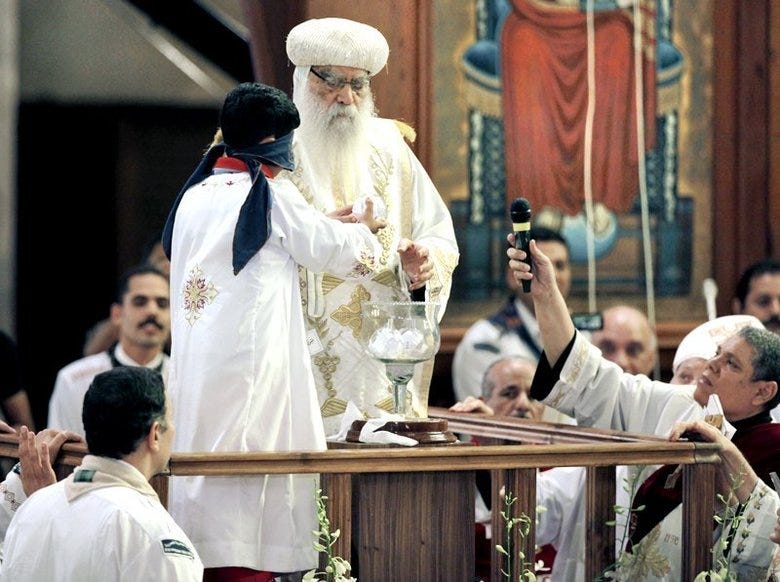
Nevertheless, further measures were often taken. At the start of the bewilderingly complicated procedure (involving several rounds both of allotment and election) that selected the Doge of Venice, the youngest member of the inner council would go out into St. Mark’s Square and choose the first boy he found who was under 15 and of common birth. The boy would then brought into the Doge’s Palace, blindfolded, and made to serve as the ballotino, drawing balls (balote) at various stages of the process. (And yes, this is where we get our word ‘ballot’.) The use of a blindfolded boy to draw lots is still used in the selection of the Pope of the Coptic Orthodox Church in the procedure shown below. There’s no sign that the boy in the Uthiramerur procedure is blindfolded, but he does have to be illiterate - almost as good in a procedure involving ballots with writing on them.
Coming to Greece now, although the Athenians famously wrote the names of politicians they wanted to expel or ‘ostracize’ on pottery sherds (ostraka), Greek city-states did sometimes also use leaves for voting, if not for allotment. (Since this was in the Mediterranean, it was the olive leaf, not the palm leaf, that they employed.) In the fifth century BC the citizens of the Greek city of Syracuse in Sicily had a ‘petalism’ procedure that was very similar to the Athenians’ ostracism, except that the Syracusans wrote the names of the politicians they wanted to expel on leaves (petala). On the Cycladic island of Ceos, elections for some local officials apparently involved people writing the names of the candidate they preferred on olive leaves. And even in Athens, members of the classical city-state’s powerful central council could be expelled in a procedure that involved voting with olive leaves and was known as the ekphyllophoria (literally ‘the carrying out of leaves’).
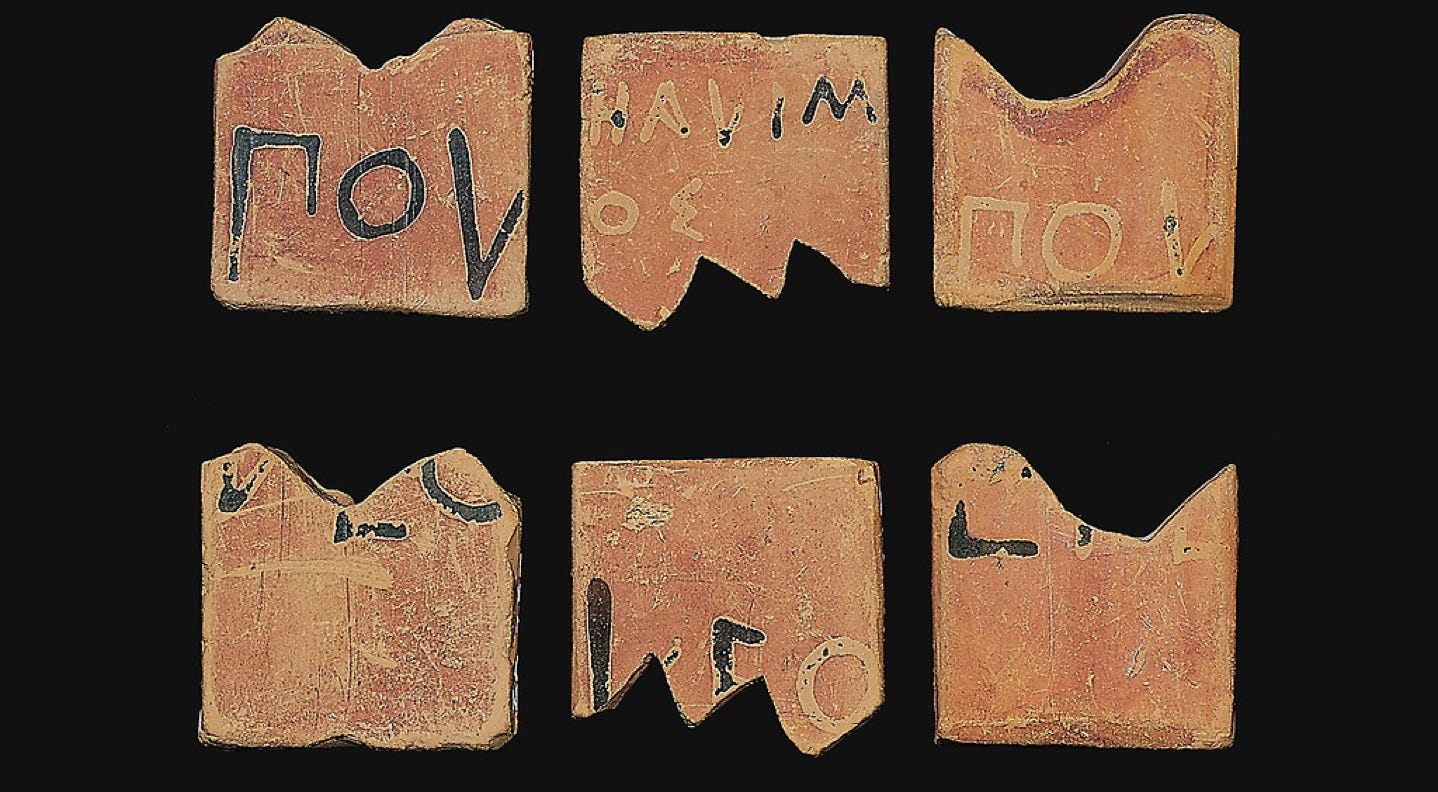
Just as the Uthiramerur procedures involved local ‘wards,’ Greek city-states also made use of geographical subunits in their allotment procedures. Some of Athens’ officials were selected in a two-part allotment procedure which involved the city’s demes (geographical sub-units which have been translated as ‘wards’). There was an allotment in the demes to select each deme’s representatives from volunteers. And there was also a central procedure that used the clay tokens below to randomly allocate deme representatives to the different offices in numbers that were proportional to the number of citizens in each deme. (How exactly this worked is too complicated to go into here, but thankfully there’s an excellent recent paper that unpacks it in some detail.)
As with the Uthiramerur procedures, ancient Greek city-states also often allotted citizens onto multi-member committees. While at Uthiramerur there were two committees of twelve and one of six, Athenian committees tended to have ten members. Some (and possibly all) of the officials selected using the clay tokens below sat on boards of ten citizens.
Finally, it is always important to note that ancient Greek democracies had a higher bar for participation in politics than we do today (even if opportunities for participation for those who were part of the franchise were much more frequent and substantive). For the Athenian offices I mentioned above, those who volunteered for initial allotment in their demes naturally had to be male Athenian citizens, a status that also required them to be free (that is, not slaves) and to have two Athenian parents. As we shall soon see, the Uthiramerur inscriptions feature much higher pre-requisites for the allotment procedures they describe, a fact that has significant implications for the question of how democratic these procedures were.
A lot changed
At this point, I would like to draw attention to something which is often glossed over - and that has been glossed over up to this point even in this piece. This is that there are actually two inscriptions that describe allotment procedures at Uthiramerur (two different procedures), and they were inscribed in two different years. Curiously, Thapar mentions only ‘an inscription' (p. 175), and then prints a translation only of the second inscription. Sintomer is more accurate, mentioning ‘two remaining inscriptions dating from 917 and 921 CE’ (p. 66). As the extensive and detailed discussions of Venkayya and Sastri make clear, there are in fact two inscriptions from the twelfth and fourteenth years of the reign of Parantaka I, that is, from the years 918-19 and 920-21 after Christ.
The main differences in the procedures described in the two inscriptions is that in the first, the wards allot their own representatives, while in the second, the ward representatives are allotted centrally. (In both cases, the representatives are then allotted to the boards.) But the most glaring difference between the two inscriptions is who they exclude from the allotment.
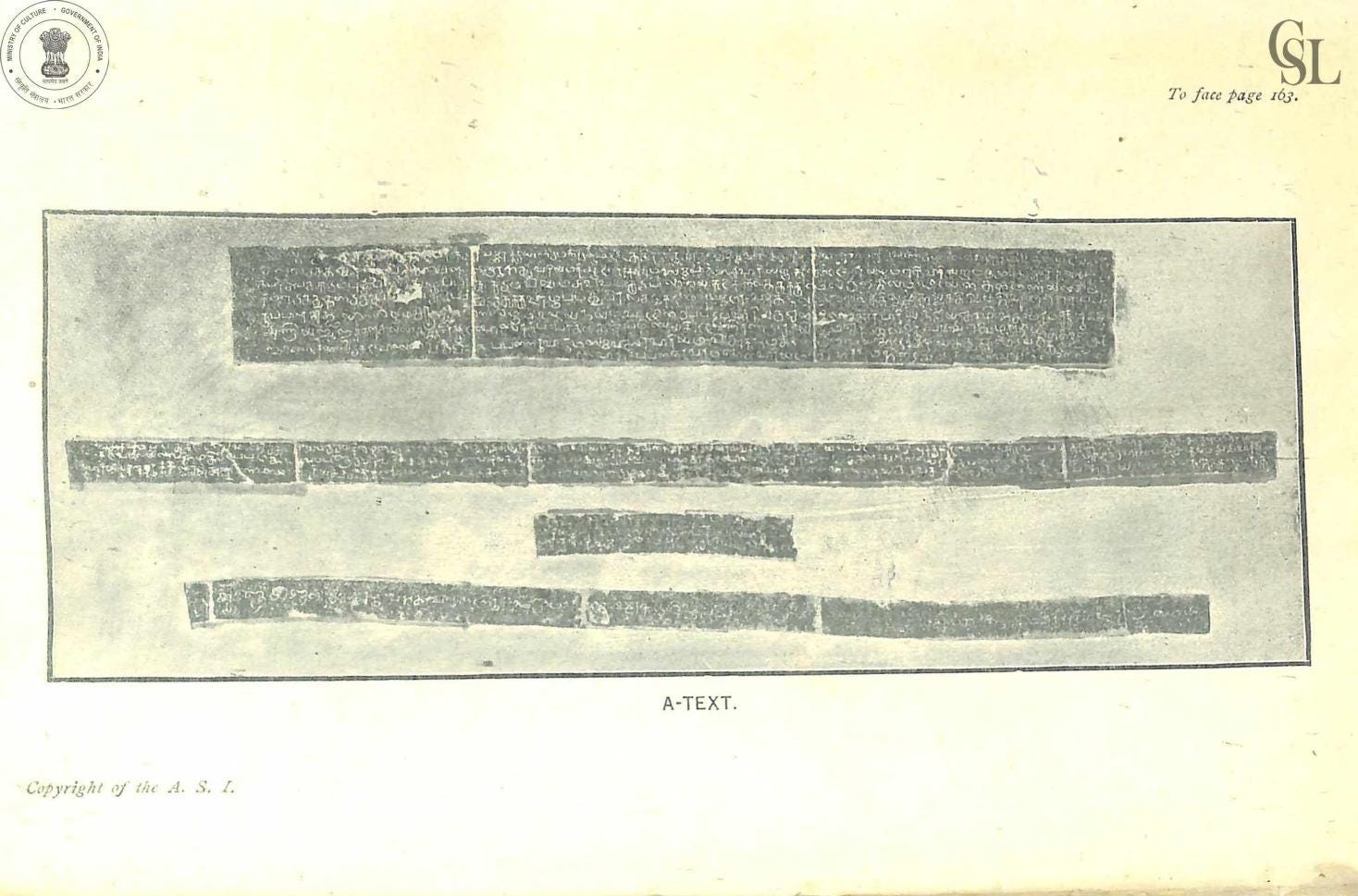
The first inscription (below) states that the allotment shall be ‘from among (the residents) who have not been on any of the committees for the last three years and who are not close relations of the great men just retired from the committees.’ ‘The name may be put down of anyone,’ it goes on ‘who owns more than a quarter of tax-paying land; is living in a house built on his own site; is below the age of sixty and above thirty; is known to be learned in the Vedas and Sastras and to be conversant with business; possesses honest earnings and has a pure mind.’ It also says that ‘those who have once served on (any of) the committees other than the Annual Committee shall not have pot-tickets with their names put into the pot in choosing men for that committee subsequently.’
That may already seem like a fair-sized list of exclusions. The second inscription, though, includes a far more extensive list of people who are not to be included in the allotment. As Venkayya summarizes it, as well as a a number of qualifications very similar to the first set, this includes ‘(a) defaulting committee members and their relations however remote; (b) incorrigible sinners and their relations however remote; (c) outcastes until they perform the necessary expiatory ceremonies; (d) those who are mentally or morally disqualified;’ and ‘(e) those who are themselves disqualified but do not transmit their disqualification to their relatives’ (p. 136).
It is worth working through the different types of qualifications and exclusions on the second inscription just to get a sense of quite how extensive and fine-grained they are. First of all, we have a very similar set of qualifications to the first inscriptions: a man hoping to be allotted, 'must own more than a quarter of tax-paying land…must live in a house built on his own site…must be below 70 and above 35’ and ‘must know the Mantrabrahmana.’ Also, ‘even if one owns only one-eighth of land, he shall have his name written on the pot-ticket to be put into the pot, in case he has learnt one Veda and one of the four Bhasyas.’ In addition ‘only such as are well conversant with business and are virtuous shall be accepted and one who possesses honest earnings, whose mind is pure and who has not been on any of the committees for the last three years’ can be entered into the draw.
But we are only just getting started. Because anyone ‘who has been on any of the committees but has not submitted his accounts, and all his relations specified below’ will also ‘not have their names written on the pot-tickets.’ The relations are specified as
(1) The sons of the younger and elder sisters of [a man’s] mother.
(2) The sons of his paternal aunt and maternal uncle.
(3) The uterine brother of his mother.
(4) The uterine brother of his father.
(5) His uterine brother.
(6) His father-in-law.
(7) The uterine brother of his wife.
(8) The husband of his uterine sister.
(9) The sons of his uterine sister.
(10) The son-in-law who has married his daughter.
(11) His father.
(12) His son.
And that is not all. The following sorts of men will also be excluded from the draw:
A. One against whom incest or the first four of the five great sins are recorded and
B. All his relations above specified…
C. One who has been outcast for association with low people…until he performs the expiatory ceremonies;
D. One who is foolhardy...
E. One who has stolen the property of others…
F. One who has taken forbidden dishes of any kind and who has become pure by performing the ghee expiation…
G. One who has committed [unclear] sins and has become pure by performing expiatory ceremonies;
H. One who having been a village pest has become pure by performing expiatory ceremonies;
I. One who is guilty of incest and has become pure by performing expiatory ceremonies.
Why the change?
It is not clear why so many additions to the qualifying criteria for the allotment procedure were felt to be necessary, and only two years after the original procedure was rolled out. Some of the extra criteria that were added in 920-21 can be seen as attempts to patch up vulnerabilities with the first procedure that had become apparent almost immediately. So, for example, the list of proscribed relatives of committee-members who did not submit their account is clearly meant to stop corrupt officials from retaining influence over the committees through family-members.
Many of the other new qualifying criteria, though, are less easy to justify as pragmatic attempts to close loop-holes. Some of them are directed against moral infractions, including incest (mentioned in two of the new criteria), stealing, ‘the first four of the five great sins,’ and the unclear category of sins mentioned in criterion G. Others seem to have a class element, such as the ban on those who have eaten ‘forbidden dishes’ (an important element in the caste system), on those who are outcast ‘for association with low people,’ and on those who have been ‘foolhardy’ or ‘village pests.’ It is hard to imagine that anyone was able to document any real problems on this front in the two years that the original procedure was in operation.
Instead, the additions seem to be reflective of prejudice and fear - fear that the new system would allow the committees to be infiltrated by immoral, lower class types. Fear, in other words, that the new allotment procedure was too egalitarian, and had gone too far. And although we can’t be sure what exactly led to the new criteria being added, considerations of caste cannot have been far away. One lesson that the two inscriptions from Uthiramerur may teach us, then, is how hard it can be for system of political equality to be created and sustained in a civilization that has high levels of social inequality.
Not all elites are created equal
We should note, moreover, that the highly stratified social context means that both procedures - even the procedure described in the first inscription - have some major limitations as examples of the use of sortition for democratic ends. We should recall that Uthiramerur was, after all, a brahmadeya village, a community of men of the Brahmin class, and that the assembly that set up both the allotment procedures described above was a sabha - an elite council of Brahmin. We should also remember that all of the criteria above applied only to men, so that the first, implicit qualifying criterion - that you had to be male - had already disqualified half of the population before the more precise criteria were even applied.
Of course, this is notoriously true of ancient Greek democracy as well. It could also be argued that the citizens of ancient Greek democracies represented a kind of elite caste, with citizen males making up only 10-20% of the total population of classical Athens.
But the Brahmin caste was always a much more elite group, and one that had little truck with egalitarian ideology even within its ranks. Although we cannot be sure what proportion of the total population of the Chola Empire was made up of Brahmins, 19th century census data gives figures of only 3-5%, and it would be surprising if the historical population of Brahmins was ever spectacularly higher than that. And while many - indeed, most - of the citizens of Greek city-states viewed themselves as ordinary citizens, even the most lowly Brahmin were ritual specialists, set apart for their ritual purity, their knowledge of the scriptures, and, ultimately, their spiritual superiority.
As if this was not enough stratification and filtering, the composers of the Uthiramerur inscriptions went out of their way to try to ensure that their committees were staffed only by members of a super-elite. This is true even of the first inscription, which restricts the procedure to Brahmin males with a certain amount of land and property, and also throws in a category that is so vague and subjective (‘a pure mind’) that it must have given the most powerful local Brahmin an effective veto over individual candidates. The second inscription, of course, adds several more vague and subjective criteria (not ‘foolhardy,’ not a ‘village pest’) and introduces several more mechanisms designed to filter out men deemed to be immoral according to the system of varnas and jatis.
There is very little of this sort of thing in ancient Greek democracy, at least by classical times. Yes, it is true that Solon introduced four ‘castes’ (as we could call them) based on property in the early 6th century BC, and that initially only citizens from the top one or two categories could be allotted into certain offices (most famously, the archonship) in the early fifth century. But even this limitation had been relaxed by the middle of the fifth century, and any remaining restrictions were a dead letter by the fourth. For the most part, sortition in Athens was ‘from the whole citizen body’ - a body of citizens that were conceived of as equals. That was precisely why sortition was seen as such a democratic institution.
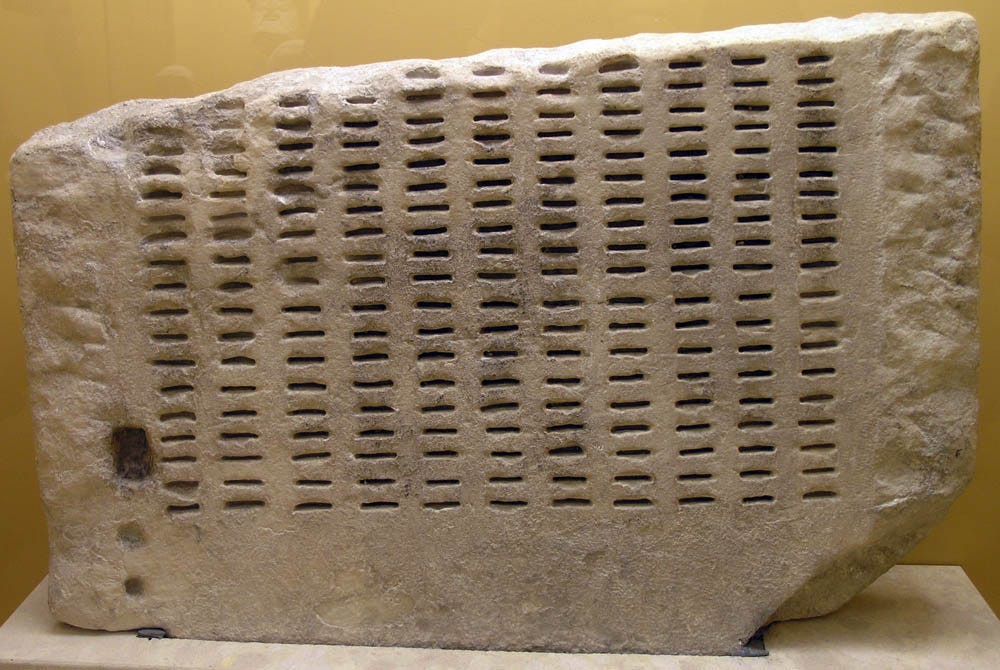
And all of this is precisely why Greek democracies remain perhaps the best example of institutionalized popular rule before modernity. Ancient Greek democrats’ use of sortition - which included the employment of ingenious allotment machines such as the one above - is also richly documented both in textual sources and in archaeological finds, in Athens and in several other city-states. All of this is very different from the Uthiramerur inscriptions, two isolated inscriptions from a single village describing a couple of allotment procedures that are unattested anywhere else in India, and that were apparently seen as so radical that they were carefully and deliberately hedged around with elitist filtration mechanisms.
Indian democracy - whence and whither
What does all this mean for the ‘Uttaramerur model of democracy’? It means that the concept is, at best, somewhat exaggerated. Speaking of an ‘Uthiramerur model of democracy’ is, I would suggest, much more perilous than speaking of an ancient Athenian model of democracy, because the sortition procedures in the Indian case were restricted to a much smaller elite. Contrary to Prime Minister Modi’s suggestion, therefore, the Uthiramerur inscriptions do not really codify ‘the principles of democratic participation.’
Nor do they constitute decisive evidence that India was (to quote Mr Modi again) ‘the world’s oldest democracy’ or ‘the mother of democracy.’ The earliest institutionalized forms of popular rule that we have plentiful evidence for are still ancient Greek city-states (including some that were very likely democratic even before Athens was). And democracy did not spread around the world from India, as Modi’s ‘mother of democracy’ image would seem to suggest.
Admittedly, the naive but common view among some in the West, that we inherited our democracy as a straightforward inheritance from ancient Greece, is also wrong. The ancient Greek precedent may have helped democracy emerge when the conditions had become propitious for it in the West. But the (really quite recent) emergence of representative democracy in modern Western nations had more to do with those underlying economic and social conditions than with the Western historiographic or philosophical traditions.
Once modern democracy did emerge in the West, though, its spread to other parts of the world was almost entirely a product of Western influence (as well as of those still crucial underlying economic and social conditions, of course). This can be seen from the way that virtually all of the world’s current democracies are representative democracies with elections, congresses or parliaments, presidents or prime ministers and so on. That obviously also applies to India, whose 1950 constitution established a version of the Westminster system. Whatever the evidence is for village assemblies and the panchayat system, modern India’s governmental system does not derive from them.
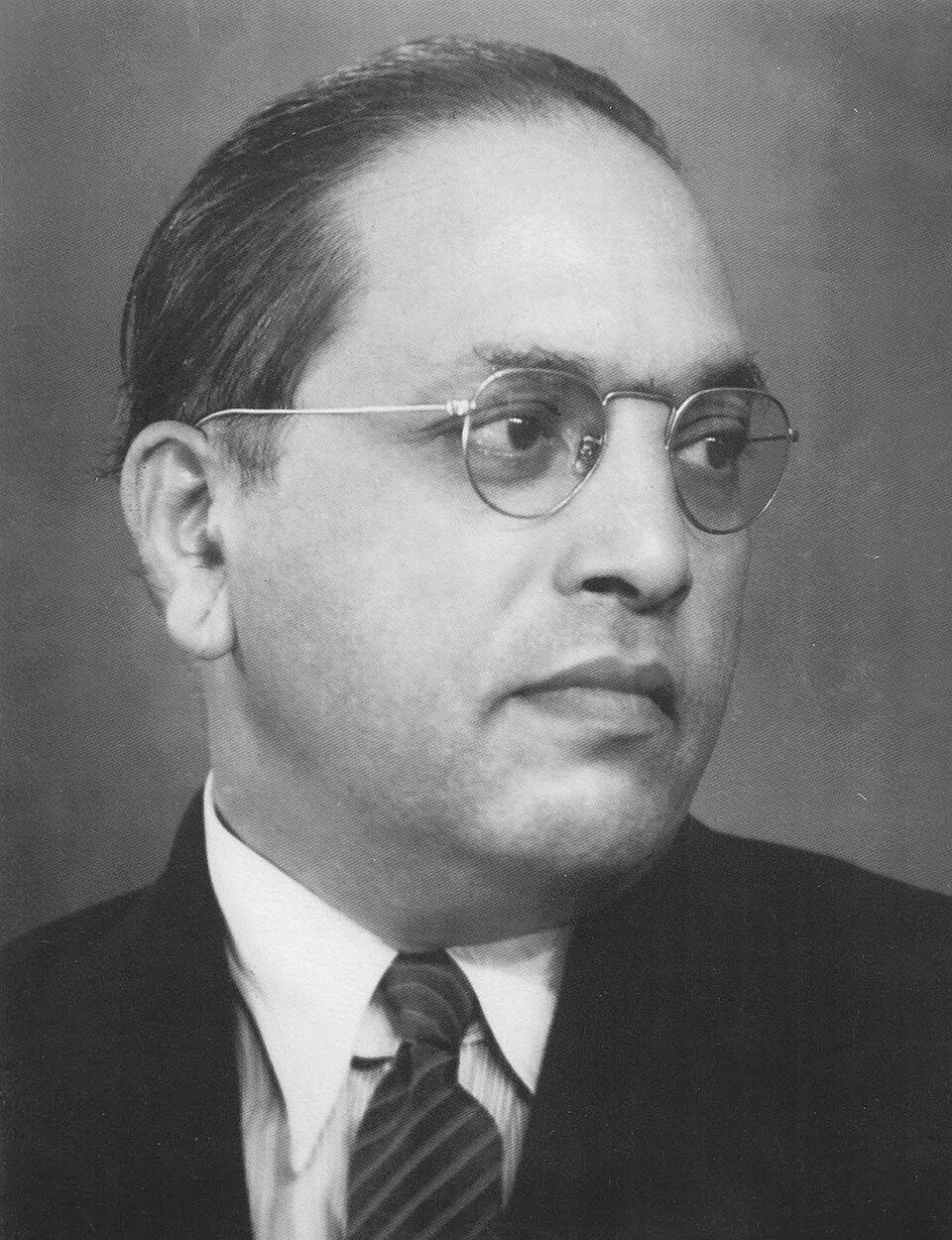
Prime Minister Modi errs again, then, in claiming that ‘democratic governance in India has ancient origins.’ There may be some traces of democratic thinking in ancient Indian texts, but many of those same texts (and I am thinking especially of the Gita here, I am afraid) surely put paid to the idea of a ‘democratic spirit’ that was ‘integral’ to India’s ‘civilization ethos.’ With the possible exception of Buddhism, India did not really give birth to any very influential ‘democratic traditions’; and though some of the states of the Mahajanapada period (c. 600-300 BC) were broadly republican, they unfortunately did not issue in any very sustained ‘history of democracy’ on the sub-continent. Far from a local democratic spirit being suppressed by ‘centuries of colonial rule,’ the ideas that shaped the thinking of the framers of modern Indian democracy (such as Ambedkar, below) were as much Western as they were Indian.
None of this is meant to denigrate India, or to deny its considerable contributions to global culture. Indian civilization has an antiquity, grandeur and coherence that should give even the most determined post-modern sceptics of ‘civilisational thinking’ pause. The Upanishads and Vedas are older than the Iliad, and the Mahabharata is some 15 times longer. Indians gave the world the mathematical concept of 0, not to mention four of the world’s great religious traditions in Hinduism, Buddhism, Sikhism and Jainism.
To the extent that this great civilization has been unfairly marginalized in the past, it makes sense for modern Indians to want to take more pride in its achievements. National pride, though, can be an unreliable guide to history, and some of the efforts of the more extreme proponents of the Hindutva ideology have undoubtedly done more harm than good to India’s ultimately irrefutable claims to a central place in global cultural history.
Not all the claims about democracy at Uthiramerur, and still less about historical democracy in India, have been a product of extreme Hindu nationalism, of course. But it may be that the eagerness with which Uthiramerur has been held up as a ‘model of democracy’ has more to do with India’s rising place in the world, and with its colonial history, than with hard historical evidence.
If I have been sceptical here about Uthiramerur as an instance of democracy, or of a fully democratic use of sortition, though, I can add, in closing, that it is undoubtedly a very interesting historical case of sortition, pure and simple. And that one of the advantages of examining one’s past with a cool head is that it can allow us to extract what we can now recognise as good ideas from habits and customs that limited them, and which they once seemed inextricably bound up with.
I said above that one of the lessons of Uthiramerur is how difficult it may be to found enduringly democratic institutions in a socially hierarchical country. India has now had representative democratic institutions for almost 80 years, though - despite the fact that it is still markedly poorer than most other democracies. And even if the caste system still exerts its casual cruelties, India’s economic miracle is steadily expanding the nation’s already broad middling class.
In this context, it may be that there is a genuine opportunity for Indians to become leaders in the integration of allotment within a larger representative democratic structure. Even if the image of India as a democracy since ancient times is overblown, that at least one Indian town once experimented with random selection is undeniable. Modern Indians who would like to carry forward their ancestors’ experiments with random selection - and perhaps without their elitist mindset - will find plenty of ideas in the texts inscribed on the walls of the Vaikunda Perumal Temple in Uthiramerur more than eleven hundred years ago.
“additions seem to be reflective of prejudice and fear”
I believe this is where you’re mistaken. If they were totally exclusionary, then why have a clause that says “until expiatory ceremony is performed” which is most likely a yajna or fire ritual. Even Hindus kings went through similar expiation rituals like Sautramani Yajna, Rajasuya yajna.